
South Korea has begun a nationwide celebration marking the 100th anniversary of Hangeul Day, with exhibitions, performances, workshops and public events scheduled from October 6 through October 17. The program, titled “Hangeul Beside Me,” is centered in Seoul’s Gwanghwamun Square but also extends to museums, cultural institutions and local communities across the country. The anniversary is significant because Hangeul Day commemorates the Korean alphabet and its role in expanding literacy and cultural identity. Unlike many national language celebrations, the 2026 program is designed not only as a historical commemoration but also as a public-facing cultural festival. Organizers are presenting Hangeul through visual design, performance, education and technology, giving visitors multiple ways to experience the writing system beyond traditional classroom study. Events at Gwanghwamun Square include the Hangeul Hanmadang program, which features performances, exhibitions and more than 20 hands-on activity spaces.
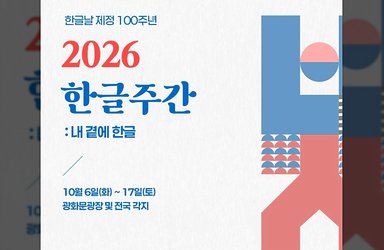
Visitors can expect demonstrations and installations built around Korean letters, as well as programming intended for families and international audiences. Evening activities include large-scale video works projected around central Seoul, adding a contemporary visual dimension to the anniversary celebrations. Museums are also using the occasion to connect Hangeul with broader histories of communication and accessibility. The National Museum of World Writing Systems in Incheon opened a special exhibition on Hunminjeongeum, the fifteenth-century text that introduced the principles of the Korean alphabet. The exhibition focuses on the history of Korean Braille and its development over the past century, linking Hangeul’s legacy to wider efforts to make written communication more inclusive. The National Hangeul Museum and other institutions are offering lectures, educational programs, competitions and exhibitions during the festival period.
Local governments, including Sejong City, are preparing their own Hangeul-themed events, while 22 Korean language and culture centers are hosting workshops and contests. The program therefore combines national ceremonies with smaller activities that visitors can encounter in different parts of Korea. For travelers, the festival offers a timely way to explore Korean culture through public spaces rather than ticketed entertainment alone. Seoul’s central events are especially accessible, while the museum exhibitions provide more detailed context for visitors interested in the alphabet’s history. The full schedule runs through October 17, with additional programs taking place nationwide.